


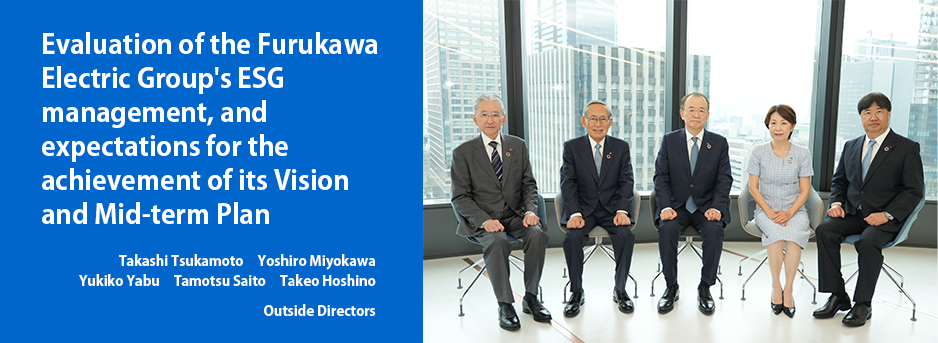
Guided by Vision 2030, which sets out our desired state for 2030, we are now pursuing organizational restructuring and M&As as we enter the execution phase of our business portfolio transformation. In this section, Representative Director Satoshi Miyamoto joins Outside Directors Takashi Tsukamoto and Sayaka Sumida to discuss the Board’s role in accelerating this transformation. They also talk about recent initiatives, including changes in organizational structure to strengthen corporate governance.
Miyamoto:
Under Vision 2030, the Group has steadily advanced initiatives in its 2025 Medium-term Plan, including business and organizational restructuring, M&As, and other strategic investments. How do you evaluate these actions to transform the business portfolio?
Tsukamoto:
Vision 2030 sets out the ideal image of our business portfolio, and under the 2025 Medium-term Plan we have taken decisive actions to realize that image. I feel that these efforts are now beginning to produce results. In April 2025, we carried out a large-scale global organizational restructuring in the Communications Solutions business, including the establishment of Lightera Holding G.K. in the optical fiber and cable products business.
I believe that business portfolio transformation requires decisions and actions that involve risk-taking, as well as a stable management foundation to carry them out. While the Group’s performance was difficult at the start of the 2025 Medium-term Plan, it has since recovered, and I feel we have finally entered the stage where we can dynamically execute the vision we have set out.
Sumida:
It is true that our performance was sluggish in the first half of the plan, but in our role as Board members we advised on the need for swift transformation. Even under those conditions, we steadily took action, and I feel that the pace of business portfolio transformation has accelerated, especially since FY2024 as our performance recovered. By focusing investments particularly in data center–related areas, I feel we are beginning to establish growth drivers for the future and are moving closer to realizing Vision 2030.
Miyamoto:
In the first half of the Plan, in particular, the Company lacked the mindset and framework to fully carry through the transformation, and the Board voiced strong criticism. In response, we introduced ROIC and other performance indicators and established the Business Portfolio Review Committee, thereby strengthening the standards and discipline for putting transformation into practice. In light of these initiatives, I believe our concrete actions are finally producing results.
Miyamoto:
Among recent moves to review our business portfolio, the organizational restructuring of the optical fiber and cable products business was particularly significant. This led to the establishment of Lightera, which Mr. Tsukamoto mentioned earlier. Until now, the Optical Fiber and Cable Products Division in Japan, OFS Fitel, LLC in North America and Europe, and Furukawa Electric LatAm S.A. in Latin America leveraged their regional characteristics and strengths to pursue their own business development. However, demand has been rising for building an optimized global supply chain related to the data center market. The need for fast decision-making from a global perspective has also increased. In response, we integrated these three units and shifted to a unified business management structure.
Tsukamoto:
First of all, I would like to commend this major global organizational restructuring, which was launched with a view to future growth. However, many challenges still remain. We must build sales and production systems that can accurately respond to global demand trends and steadily resolve each challenge. I expect the Company to approach this with strong determination and turn it into solid results.
Sumida:
I feel the establishment of Lightera conveys a strong message that we are executing management from a global perspective. The Board will continue monitoring developments closely to ensure this message translates into action.
Miyamoto:
Indeed, Lightera represented a concrete expression of the Group’s seriousness and determination toward global business management and execution. However, what we have now is only the “framework” created through organizational restructuring, so the real work starts here. With markets changing quickly, we are determined to seize every opportunity, deliver results, and see this through to completion.
Miyamoto:
To accelerate business portfolio transformation, under the 2025 Medium-term Plan we established a “strategic investment limit,” through which we have actively pursued M&As and capital alliances. For many years, the Group had not engaged in discontinuous investment, so we were unable to fully leverage the framework when it was first introduced. Today, however, its use has advanced, and we are seeing positive changes in internal awareness and behavior toward growth investments. The Board of Directors has also shared a range of opinions and engaged in active discussions regarding this strategic investment limit.
Tsukamoto:
At Board meetings, we repeatedly asked, “Why not make greater use of the strategic investment limit and take action accordingly?” In management, I always keep in mind the need to make decisions and take action, even if it involves pain and breaking free from constraints. I stated that we should approach business portfolio transformation more aggressively and with genuine determination.
Under these circumstances, we have recently engaged in M&A deals aimed at medium- to long-term growth, starting with capital alliances involving Hakusan Inc. and the former Fujitsu Optical Components Limited*. Our progressive use of the strategic investment limit has built a stronger deal pipeline, enabling us to select the most suitable investments from among multiple options. This is a positive development.
Sumida:
Given the broad range of the Group’s businesses, capital investments and R&D spending tend to be dispersed, creating unavoidable constraints on the amounts we can allocate. I believe this reflects our history as a B2B company that has long supported social infrastructure, together with our orientation toward sustainable growth along that trajectory. At Board meetings, we repeatedly discussed whether concentrating investments might lead to stronger growth. We also debated how best to use cash generated from asset sales to make growth investments.
Miyamoto:
I feel we must continue discussions on optimizing the business portfolio at Board of Directors’ meetings going forward.
*Now Furukawa Fitel Optical Components Co., Ltd.
Miyamoto:
In June 2025, we transitioned to a company with an Audit & Supervisory Committee aimed at strengthening the Board’s oversight function and separate execution from supervision. Could you share your views on the background and process that led to this change in governance structure?
Tsukamoto:
The concept of driving transformation by restructuring our organization was not new. However, our transition to a company with an Audit & Supervisory Committee represents the embodiment of President Moridaira’s strong resolve and management intent to reinforce execution. With our business portfolio transformation underway and the Group moving into a growth phase, I believe this transition was done with good timing.
Changing our governance structure is not a mere formality but an important issue that goes to the essence of our organization. That is why I also raised the question, “If we are truly serious about strengthening corporate governance, why not transition to a company with a Nominating/Compensation Committee and other bodies?” Considering this background and process, I believe the decision to change the governance structure and make the transition was the right one.
Sumida:
I also feel this change represented a major decision for the Company. Modifying our governance structure sent a clear message that we are determined to change.
On the other hand, I also heard concerns that reducing the number of Audit & Supervisory Committee members from six to three might lower the quality of audits. I understand those concerns, but in a large organization like ours, audits are conducted on the basis of internal controls and risk management systems, whether by statutory auditors or by the Audit & Supervisory Committee. The key is to strengthen collaboration with internal audits, including monitoring of related systems, to build an audit function appropriate for a global company.
Miyamoto:
The change in structure should serve as an opportunity to foster a relationship in which internal and outside directors can deliberate as equals with broad and high-level perspectives. To achieve this, the executive side must further refine its business strategies and strengthen its execution capabilities, while the Board of Directors must create an environment for intensive discussions with a medium- to long-term perspective. I am confident this change in governance structure marks the starting point of a transformation that will take the Group’s management capabilities to the next stage.
Miyamoto:
I would like to hear your assessment of the Board’s effectiveness to date. From a broad perspective, please share your views on such matters as agenda setting, the depth of discussion, and whether the environment enables directors to easily exchange information and opinions.
Sumida:
In the annual evaluations of the Board’s effectiveness, many critical opinions are raised, and the head outside director conveys these views clearly to the executive side. We are committed to taking any steps necessary to strengthen the effectiveness of the Board of Directors. After the governance restructuring, we must focus even more on high-level, strategic discussions, which I feel will place greater demands on the capabilities of outside directors.
Miyamoto:
To ensure even higher-quality discussions, we on the executive side must also find better ways to provide information and set up forums for discussion. As outside directors, what are your views or requests regarding how we can further improve the quality of these discussions?
Sumida:
While I greatly appreciate the sharing of materials and minutes from management meetings, there remains an information gap between us and internal directors. I sometimes feel that the discussion time in Board meetings or opinion exchanges with the executive side are not sufficient. It depends on the issue. When discussing the medium-term management plan, for example, it would be beneficial to hold off-site meetings and other forums for more focused discussions.
Tsukamoto:
I would like to raise two points. The first concerns the continued evolution of the relationship between internal and outside directors. To enable high-quality discussions, outside directors must have a deep understanding of the executive side’s concerns and the Company’s management policies. By gaining accurate knowledge of these matters, outside directors can express their views appropriately, and their comments, which reflect different perspectives, foster interaction within the Company, enabling truly valuable discussions.
My second point concerns the role of the Board in the age of generative AI. While AI can provide answers to questions, it cannot formulate the right questions. I believe that the ability to raise essential questions that AI cannot replace will determine the quality of Board discussions in the future.
Miyamoto:
Finally, could you share your future expectations and outlook from a medium- to long-term perspective?
Sumida:
The Group’s businesses are largely long-term initiatives related to social infrastructure, and we are currently in a seeding phase with a view toward 2030 and beyond. At the same time, generating cash flow and profits in the near term are essential, and balancing medium- to long-term perspectives with short-term results remains a challenge. As a Board member, I want to support bold initiatives while maintaining this balance.
Tsukamoto:
Under the 2025 Medium-term Plan, our performance is recovering, and we have entered the execution phase of our business portfolio transformation. Looking ahead, I believe constructive discussions with a sharper focus on medium- to long-term growth will become increasingly important. Moreover, our transition to a company with an Audit & Supervisory Committee is not simply a defensive measure to strengthen governance. Rather, I see it as a proactive approach that should drive corporate value enhancement, and our responsibilities as outside directors and expectations placed on us are rising accordingly.
Miyamoto:
Through this dialogue with both of you, I was once again reminded that the Group is now truly entering a growth spiral. Moreover, our transformation under the 2025 Medium-term Plan is making steady progress, and I am confident that by further accelerating this progress, we can chart a solid growth trajectory toward 2030. We on the executive side will further refine our execution capabilities and work together with outside directors to enhance corporate value in a sustainable manner.
October 2025

